
Cultivating Creativity and Artful Living with Children
If you’re looking for gentle ways to weave a little more everyday creativity into your children’s or grandchildren’s lives, here are a few simple ideas to try.
1. Gather the Tools!
When the children were young, I exposed them to a wide variety of art mediums— everything from watercolors, pastel crayons, washable pens, clay, and different types of paper (including the butcher paper with which I covered the dining room table!) Thanks to thoughtful grandparents and friends, their birthday presents and Christmas stockings were always well-stocked with supplies, which included things like Sculpey Clay, beading kits, raw wood projects (like a castle you can paint any way you like!)

2. Cultivate Appreciation of Great Art
Early on, I wanted to provide awe inspiring experiences to introduce them to the works of artists Renoir, Monet, Van Gogh, Da Vinci, Michelangelo, and other Great Masters. We were fortunate enough to live near the Blanton Museum of Art where there were fantastic exhibits. It naturally kindled a desire for them to draw everything from still life to detailed imaginary mansions, landscapes, and portraits. We loved visiting regional art museums, such as the Elisabet Ney Museum in Austin, (who famously made the marble sculptures of Sam Houston and Stephen F. Austin, that are in the Texas Capitol.) We also sought out the historic Painted Churches of Texas built by early Czechoslovakian settlers. It is a full day trip from the Austin area the churches along the county roads near Schulenburg, Texas.
(Below are photos from our visit to one of the Painted Churches of Texas, in Praha Texas, as well as the Elisabet Ney Museum in Austin.)


Every week, from the time they were small I took them to visit the local library to discover artful, beautiful children’s books. Paying special attention to look for Caldecott Medal and Newbery Award, and Bluebonnet Award winners, I combed the shelves for children’s books that were not only exquisitely worded, but featured stunning illustrations. As one illustrator noted in her bio, each page should be able to stand alone as a single work that could be framed and displayed. Finding books that met that standard for visual and literary beauty became my own quiet rule for our shelves.


3. Proudly Display their own Creations

At home, the refrigerator, of course, was a revolving art display, featuring their latest creation. But I also loved making the effort to frame select pieces of featured art on wall spaces in our home. Involving them in the framing process was half the fun: taking a trip to the local frame shop together to pick out complementary mats and frames. (Or just float art from an empty frame for a whimsical touch!)
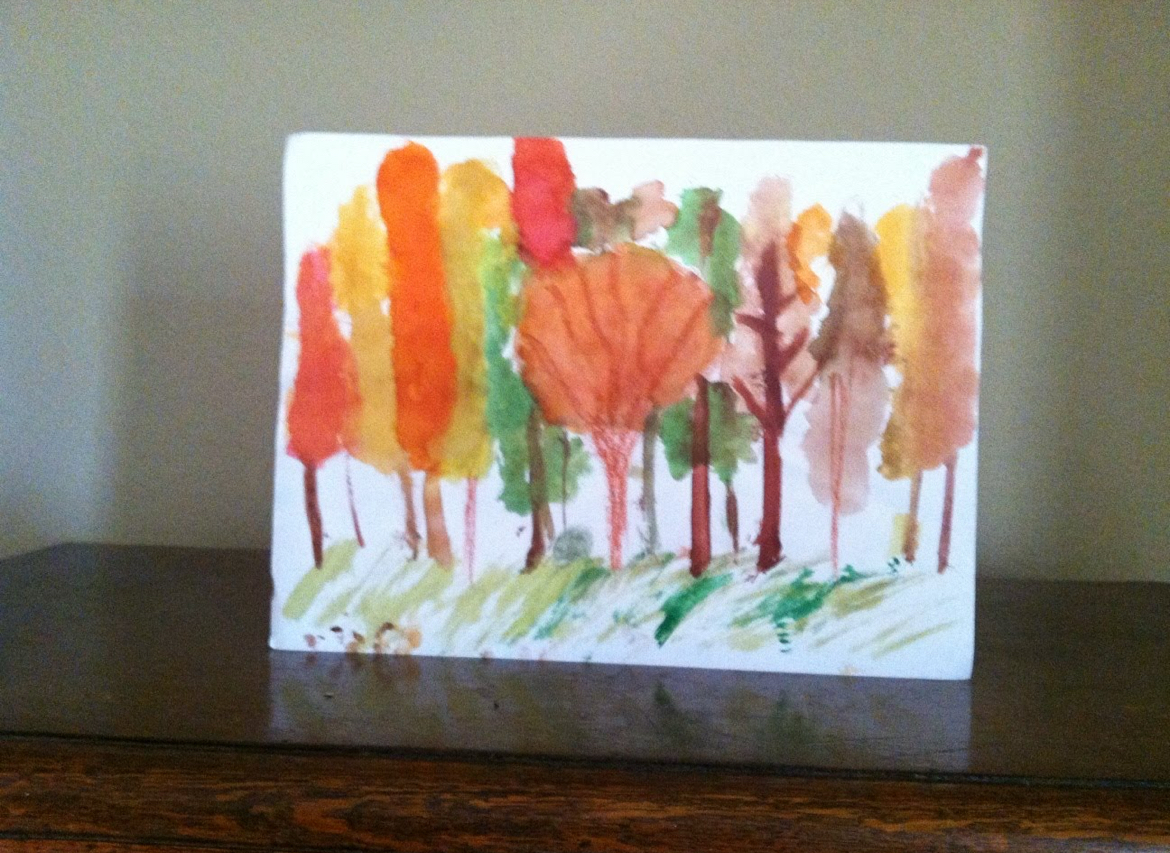
Fall leaves

Our daughter was fond of drawing her friends and family as seen in the first two whimsical pictures below.


It does not have to cost a fortune make a gallery wall that can display your children’s art work. You can purchase second hand thrift store frames and spray paint them black or white to offset brightly colored artwork.


Personalized clay figurines make very special gifts. Our daughter’s Sculpey creations have only gotten more intricate over time as she has gained even more experience with clay! (Early versions above, and more recent pieces below—she truly has an eye for tiny details.)


4. Create and Paint Together
Art is wonderfully contagious when shared. Even if it’s simply checking out instructional books from the library—like Drawing a Likeness by Douglas R. Graves or classic “How to Draw” guides—sitting down side-by-side makes all the difference. (—we checked out all of the art books we could find at our local library!)
Pick out some lovely note cards, find an inspiring scene, and work through the steps together. There is a quiet joy in arriving at a finished piece you’ve created alongside them. When tackling a landscape copy, I always recommend starting with a light pencil outline, blocking in the sky, trees, and flowers with watercolors, and finishing with fine-detail brushes once the layers are dry.


One of my favorite memories of this was when we pulled out several boxed Thomas Kinkade note cards when our son was almost seven. He painted each of the above with some guidance from me. He was really into it and wanted to do more and more!

Following a watercoloring guide for painting birds (above).
For those who love tiny details, they can have so much fun painting on tiny canvases or small magnets, which are easily found at local craft stores. These make the cutest little keepsakes and small gifts. If these are not readily available they may even paint empty cardboard jewelry boxes to make their own little treasure containers.


Experimenting with “useful canvases”, (like tiny a mini canvas, round refrigerator magnets, a kitten on a small vinyl ring box and a bunny on a cardboard jewelry box) . My daughter gave me these for on a special occasion….so sweetly displayed here on a dresser, alongside my Grandmother’s antique chalk bunny.
5. Enroll them in classes
When children show a genuine, growing curiosity for art and you’ve explored everything you can at home, formal lessons can open up a whole new world. Whether it’s ceramics, pottery, painting, or needle felting, there are plenty of budget-friendly avenues to explore through local art museums, community co-ops, or neighborhood studio classes. It’s also a wonderful way to build friendships with kindred spirits who share a love for making things.
A great field trip if you’re in Oklahoma is Shepherd’s Cross Farm, in Claremore. You can schedule a tour and learn about every aspect of a wool mill.


Older children may enjoy the skill of needle felted art, however, use caution as it requires the use of a sharp needle and working the wool until it takes a shape. There are many video tutorials
The above Highland Cow and Valais black nose sheep are some of the creations my daughter and I worked on together, while the very expressive monkey below is an original piece (made of Alpaca wool) for a friend.


6. Take Sketching Outdoors

Along one of the walking trails at the Philbrook Museum in Tulsa, (above in Spring and below in Autumn).

Take them outside to draw! This is one of the best practices imparted from our daughter’s first art teacher, Miss Wofford, who said “It is a whole lot more interesting to pick a bouquet of flowers, put them in a vase in front of you and draw what you see rather than draw one dimensional flowers that look more like a circle surrounded by teardrops!” As Alexandra Day, illustrator of the popular “Good Dog, Carl” series said, “Painting was a popular family recreation, and almost every family excursion included one or more easels and a variety of sketch pads, chalks, paints, and pencils.” It reminded me so much of our family when our children were younger. Sidewalk chalk drawing is great entertainment for small children. So take them out to the park and let them draw landscapes, or to a cute outdoor cafe in the town and let them draw architecture in their sketchbooks, but above all, just enjoy being creative in the outdoors!
7. Encouragement and Praise
Affirmation matters deeply. You can’t simply assume children know how much you value their creative expressions; let them hear it. As they grow and their artistic styles evolve, they may even start tearing out older sketches from their books, not realizing how wonderfully gifted they are. Bolster their confidence by going back to the way you did when they were small. —Maybe purchase a small gift such as a leather-bound sketch pad and professional pens, planning a nostalgic trip to a favorite art museum, or simply sitting down to listen as they excitedly explain the details of a new piece. Encouragement goes a long way.


Remnants of sketches torn from a book and works in progress; I still feel joy and admiration when I come across these time capsules of their journey in art. (above)
Both share a whimsical feeling. Our daughter’s whimsical style leans toward animals and characters, while her brother’s style often leans toward whimsical places, landscape and architecture.
Now that they are adults, I hope they will share more of their individual works on their own platforms, and when that happens, I will be the first to share them with you! As a parent, we give children the tools to become artists, and they will carry that with them all of their life. Whether they decide on a professional career in the arts is up to them, but they will always be able to do these things and even more as it pleases them—whether that means enjoying graphic art for charitable organizations, making personalized gifts for friends, or simply creating for the sheer joy of it.
Recommended “Artful” Picture Books for Younger Children
- Hush Little Baby by Sylvia Long – A gorgeous rendition that trades commercial items for the quiet, unfolding beauty of nature.
- Hide and Seek in the Yellow House by Agatha Rose
- Katie and the Sunflowers by James Mayhew
- Good Dog, Carl series by Alexandra Day– Delightful, nearly wordless artwork that sparks wonderful storytelling for toddlers and parents alike.
- Children’s Books Illustrated by Tasha Tudor
- Brambly Hedge series by Jill Barklem – Step into the exquisite miniature world of the mice of Brambly Hedge in this beautiful set of classic picture books.
- The Tale of Peter Rabbit and Other Classic Tales by Beatrix Potter – A wonderful addition for any child’s shelf, featuring her charming, delicate watercolor illustrations of the English countryside and woodland creatures that continue to inspire young artists to observe nature closely.
- The Mitten or The Hat by Jan Brett – A wonderful addition for children, featuring Jan Brett’s signature detailed, folk-art-inspired borders and snowy cottage-country illustrations that invite young readers to look closely at every page to discover hidden stories in the margins.
- Make Way for Ducklings by Robert McCloskey – A classic, beloved tale following Mr. and Mrs. Mallard as they search for a safe place to raise their family in Boston, featuring Robert McCloskey’s iconic, gentle brown ink illustrations that capture city life and nature alike.
- Anno’s Journey by Mitsumasa Anno – A stunning, nearly wordless picture book that records a traveler’s journey through the traditional countryside, villages, and towns of northern Europe. Filled with meticulous, gently hued watercolors, it hides countless visual puzzles, architectural details, and references to art and classic stories in every margin for children to discover.

A little peak into one of my favorite art books for children Anno’s Journey (above).
I think it could have had some influence on Ian’s art style as a ‘tween’.

He enjoyed picking out the frame for it!

Recommended Biographical and Art Books for Older Children
- 26 Fairmount Avenue series – The charming childhood story of artist Tomie dePaola growing up in the 1930s and 40s.
- “What Makes a…?” series by Richard C. Muhlberger – Wonderful deep dives into Monet, Van Gogh, Rembrandt, Degas, and Da Vinci that make abstract concepts accessible for young minds.
- The Private World of Tasha Tudor by Tasha Tudor and Richard Brown – A captivating look into the cottage-style life and artistry of a beloved illustrator.
(If you are looking for affordable copies to fill your own shelves, ThriftBooks.com is a wonderful place to hunt down pre-loved editions of many of these titles!)
And when they grow up… they will still love art!

Visit Philbrook Art Museum in Tulsa
I hope you have enjoyed this blog story as much as I have enjoyed making it and reminiscing about the time making art together! Have fun making art, and I hope you will subscribe and share with me in the comments what artful activities you enjoy with your family!
Laura