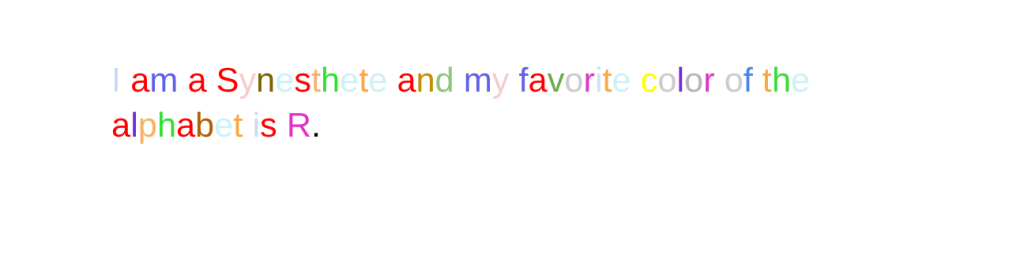
I have synesthesia and I have had it since I was a child. If you have not heard of the word, I am not that surprised because usually the it’s the folks who have who are most familiar with it.
Synesthesia is not a disorder, or condition. It does not hinder one’s life in any way. It is not an imagination of something. It, in fact, simply is. For those who have it, they know what I mean.
There are multiple types of synesthesia. I have what is called Grapheme Color Synesthesia, (letters and numbers are inherently colored), and what is called Chromesthesia, or Sound to Color Synesthia.
For Synesthetes, this has always been. Perhaps it happened when we were in the womb. But at some point, when our brain was being developed, the connection between one or more of the five senses are adjoined. Like meshed. For people with taste and color synesthesia I cannot imagine what that is like. (For the more scientific explanation see links.)
There were many known synesthetes, including Rimsy Korsokov. This is where I found out about mine. I was playing the first page of Flight of the Bumblebee. And wondered at the fact that it gave me such a sense of an adrenaline rush, each time I played it. But for some reason, I did not make myself learn the second page. I started to wonder about the composer.
My delve into Wikipedia led me to note that he had synesthesia. This was the first time I had heard of the word. As I read more about it, I began to realize that I was also a synesthete.
It gave me clarity on why I always felt that certain songs were certain colors. And therefore justified my reasons why I had always changed the background colors on slides for each song we sang at church, so that the background would “match the song.” Boom! It hit me! I realized that synesthesia was the reason I perceived a song or a chord of a song, as being a certain color. It was the reason that since my earliest memories, words were painted in certain colors. For example, my brother, Carl’s name was always yellow. Mama was a blue word and Daddy was a green one. Then I thought about how I read and reread The Chronicles of Narnia as a child. Somehow, the word Narnia was brown, Telmarines appeared orange and Calormen were unmistakably yellow. It was as if a whole new world opened up to me. It didn’t change anything. Knowing it was that way did not affect me. But it helped me understand myself better.
One day after church, I took a box of crayons after having drawn a simple blank piano keyboard. I began to fill in at random each note that I saw as a certain color. Very soon, it became clear to me that my perception of colors of the notes in music revealed themselves as a rainbow of color. Various shades blended into others.
As they changed from F to F sharp the color had mysteriously gone from deep blue to a dark purple. D minor was always green. B flat was brown. while it’s enharmonic color of A sharp was just a bright red. “A natural” was a truer sort of red while A flat was a cranberry color. G was brick red and so on it went. When I looked down at my keybord it looked something like this.
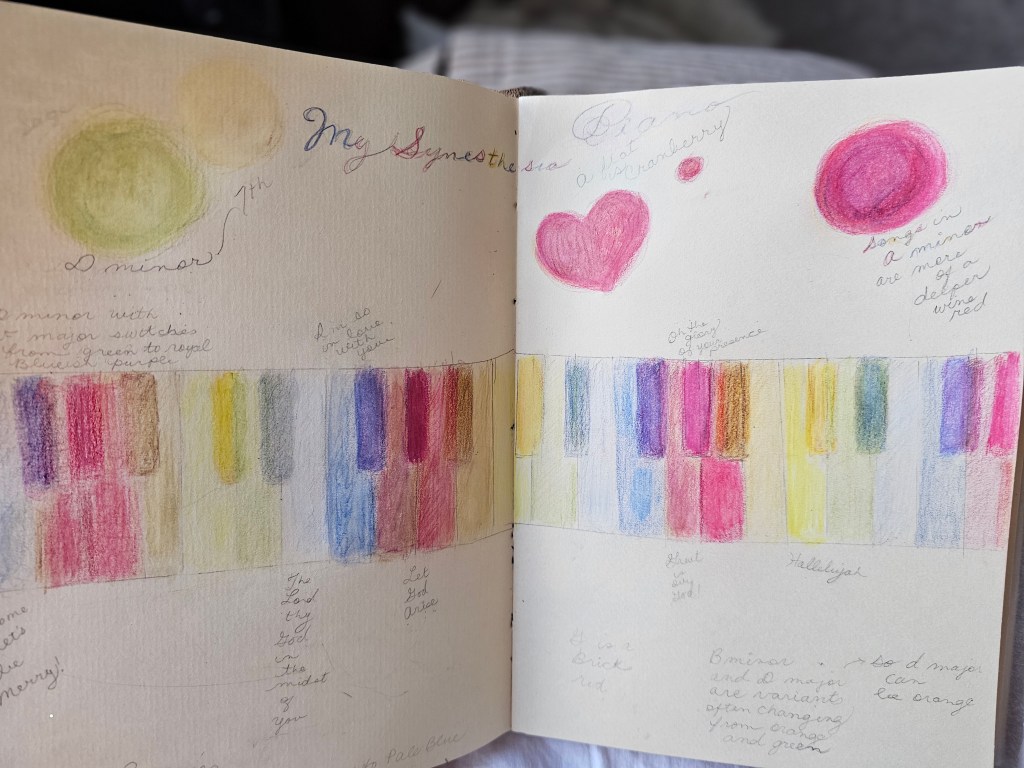
I recently tried to recreate this experience using Faber Castell water color pencils. However, it seemed more accurate using a box of crayons because this time, I did not have access to a true red. So there were less choices to work with.
Ok, this part might get weirder if you aren’t familiar with music theory but consider yourself forewarned:
One thing that is kind of neat and strange is that chords tend to blend with relative minors (such as D major to B minor) They have variations of color in how they interact. For instance, D minor is green but when the seventh degree of the scale is added (the note B) it adds B’s color, which in my case is a kind of greenish brown color like freshly picked Lima beans. D major on the other hand is an orangy color. So there is a lot of interaction between D major and B minor from Oranges to greens. The same is true with the Key of C and e minor. The light blue associated with e minor and C major’s true yellow play peacefully together like water and a yellow butterfly floating over a brook. F major is Blue but it takes on a deeper more royal almost purple look when played in a song that is in the key of D minor. E flat is that muted eighties blue.The colors are not the same for every person who has synesthesia. Someone else might see pink and chartreuse!!
If you have synesthesia, I would love it if you would add something in the comments about what type you have, what colors you see for letters or numbers and or music. Or, if you have a different type please share. I would love to learn more about it.
We are in good company with many known composers, scientists and physicians in history. Some of our fellow synesthete composers include Billie Eilish, Billy Joel, Franz List, Itzhak Perlman, Richard Wagoner and Duke Ellington. But for a more comprehensive list please visit. https://en.wikipedia.org/wiki/List_of_people_with_synesthesia
I hope you do share your thoughts and moments of realization with me. If you are like I was and just had this kind of inherent experience your whole life and you just had an epiphany about it, please let me know! ~ Laura

 Copse and Spinney
Leave a comment